
Done Dirty: Is the Media Running a Campaign Against Arsenal?
Three seasons as runners-up. A Champions League semi-final. The worst VAR record in the league. And still, somehow, Arsenal are the ones getting hammered every week on talkSPORT, Sky Sports, and the back pages. It’s time someone asked: is this bias, or are we all just imagining it?
Let’s Start With the Obvious
If you’re an Arsenal fan and you feel like every pundit on every panel is looking for a reason to have a go at your club, you’re not paranoid. You’re paying attention.
This isn’t the classic “every fan thinks their club gets it worst” complaint. There are actual patterns here — in the refereeing decisions, in the punditry, in the language used on live television — that go well beyond what you’d put down to coincidence.
Simon Jordan, not exactly known for going easy on anyone, has said he’s “tired of it.” Emmanuel Petit, a man who won the World Cup and knows a thing or two about elite football, has echoed the same. When two blokes who regularly disagree with each other are both shaking their heads at how Arsenal get treated, that should tell you something.
So let’s go through it properly. The VAR record. The pundit pile-ons. The double standards. The media narrative machine. All of it.
The VAR Numbers Don’t Lie
This is where we start, because the numbers are the hardest thing for anyone to argue with.
In the 2024-25 Premier League season, Arsenal benefitted from VAR just once. Decisions went against them seven times. That’s a net score of minus-six — the worst in the entire division, according to data tracked by GiveMeSport and ESPN throughout the campaign.
Let that sink in. One club, one season, seven VAR decisions going the wrong way.
And it wasn’t just little things either. Here are some of the big ones that directly cost Arsenal points:
- Myles Lewis-Skelly sent off at Wolves — later confirmed as a VAR error by the Key Match Incidents (KMI) panel. A wrong red card. Arsenal lost the game.
- Kai Havertz’s goal ruled out against Aston Villa — cancelled for handball in the 87th minute with the scores level. A moment that could have been three points turned into one.
- Declan Rice sent off for kicking the ball away vs Wolves — the only red card of its kind given all season. Other players did the exact same thing and got nothing.
- Leandro Trossard sent off for the same offence vs Man City — despite kicking the ball as the whistle was already going.
- William Saliba sent off vs Bournemouth — given as DOGSO (denying an obvious goal-scoring opportunity), despite being over 45 yards from goal with a covering defender nearby.
- Gabriel Martinelli denied a clear red card foul vs Newcastle — the attacker was brought down through on goal, VAR agreed with yellow.
- Havertz denied a winner vs Liverpool — the referee blew before the ball crossed the line, making VAR review impossible.
The analytics site Cannon Stats, which tracked every major VAR judgment call affecting Arsenal throughout the season, found that 57% of significant decisions went against them, compared to 43% in their favour. As the site noted: “I don’t know if this is evidence of systemic bias, but it doesn’t help to show that there isn’t.”
Meanwhile, Newcastle United finished the season with a VAR net score of plus-nine — the best in the league, according to ESPN’s full review. Somebody’s winning that lottery every year. It just doesn’t tend to be Arsenal.
The Celebration Police
If you want a perfect, almost comical example of the double standard in action, look no further than the reaction to Arsenal’s celebrations after beating Liverpool 3-1 in February 2024.
Martin Ødegaard borrowed a camera from club photographer Stuart MacFarlane. The players celebrated together. It was joyful, spontaneous, and entirely harmless.
Jamie Carragher scoffed at it on Sky Sports. Chris Sutton sounded off on BBC radio. Richard Keys — yes, him — had a go on beIN Sports.
Mikel Arteta, when briefed by his press team before a conference, admitted he hadn’t even known about the criticism until that moment. He’d been busy, you know, managing an elite football club.
Can you imagine the same reaction to a Liverpool or Manchester City player having a laugh with a camera after a big win? Can you picture four different pundits on four different platforms dedicating airtime to whether it was “respectful enough”?
No. Neither can we.
The Time-Wasting Narrative
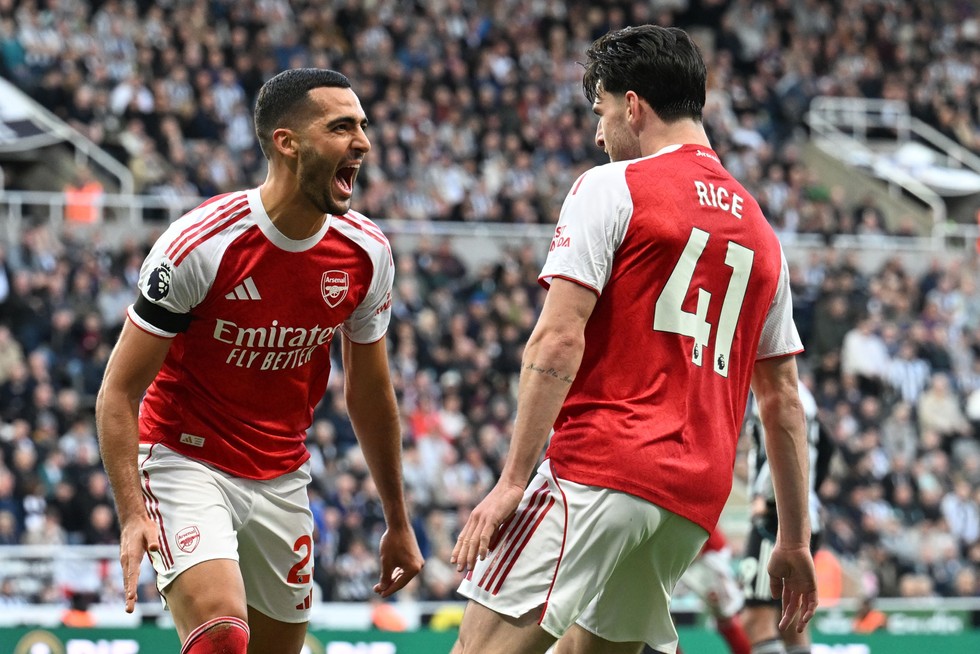
A consistent theme across multiple seasons has been the accusation that Arsenal “time-waste” and play “anti-football.” This one is genuinely interesting, because there is some truth to it — Arsenal do manage game tempo deliberately, particularly when leading. So does every top side.
But the language used for Arsenal is uniquely loaded.
When Arsenal beat Brighton 1-0 in October 2024 to go seven points clear at the top of the Premier League, Brighton boss Fabian Hurzeler gave a ferocious press conference accusing them of “not trying to play football” and “making their own rules.” Fair enough — managers get wound up after defeats.
What was more telling was how much oxygen that criticism got in the media. Hurzeler’s comments led sports bulletins. Pundits nodded along. Column inches were filled.
As one supporter-run analysis site, Untold Arsenal, noted at the time: when Man City slow down their goal kicks — a tactic they used extensively — The Sun described it as “a smart tactic.” When Arsenal do something similar, the same papers call it “dark arts.”
Two sets of rules. One for Arsenal, one for everyone else.
The Co-Commentator Question
Beyond the main pundit shows, there’s another layer to this: the actual commentary on matchdays.
The issue, as laid out brilliantly by football writer Henry Pryer in a piece for his newsletter in late 2025, is the system of assigning former players as co-commentators for games involving their old clubs. The logic is that they’ll provide insight. In practice, what you often get is barely-disguised cheerleading for one team — or, in the case of Arsenal games, analysis that focuses disproportionately on the visitors while the home team’s story goes untold.
The most cited example: Martin Keown, covering the Aston Villa vs Arsenal game at Villa Park, selected Martin Ødegaard as his Man of the Match — despite Ødegaard’s side losing, thanks to Emi Buendía’s winner. Keown, preoccupied with Arsenal, seemingly hadn’t been paying enough attention to know which Villa player deserved the award.
As Pryer wrote: “Do you know what I learned about Arsenal or being a footballer as a result of having a card-carrying Arsenal fan covering that Villa match? Nothing, that’s what.”
The problem cuts both ways — but the consequences don’t. When an ex-Arsenal man is too focused on Arsenal, it looks like bias for them. When ex-United or ex-Liverpool men spend games talking through a United or Liverpool lens, it goes unremarked because that’s just the natural gravitational pull of British football media.
The “Typical Arsenal” Problem
There’s a phrase — barely even used consciously anymore — that gets applied to Arsenal in a way it doesn’t to other clubs: the idea that losing from winning positions, or dropping points late, or failing to win a trophy despite being good enough, is somehow characteristic of them. Uniquely theirs. Almost deserved.
In 2024-25, Arsenal dropped 21 points from winning positions — their joint-worst record in a single campaign. A painful statistic.
But when the media reported it, the framing was often that it was an Arsenal problem. A mentality thing. An Arteta thing. The kind of thing that just happens to Arsenal.
The same season, Arsenal conceded a league-low 34 goals. They won 20 Premier League games. They reached the Champions League semi-finals for the first time since 2009, knocking out the reigning champions Real Madrid 5-1 on aggregate along the way. They finished second in the Premier League for the third season running — something no club had done twice in English top-flight history.
The points dropped from winning positions is worth noting. The extraordinary achievement of being that close to the best for three consecutive years? Somehow, that’s not the lead.
Why Does This Happen? (The Honest Version)
It’s worth being fair here, because “the media hates Arsenal” is a bit too simple and, frankly, a bit too convenient.
Part of it is Manchester United and Liverpool. The two clubs that dominated English football for decades have the lion’s share of fans, ex-players, and media figures. It’s not a conspiracy — it’s demographics. More fans means more ex-players in the media. More ex-players means more coverage filtered through their experience. Arsenal fans have long pointed out that 17 of the 20 Premier League referees are based north of Nottingham. Whether that leads to actual bias is debated, but the structural imbalance is real.
Part of it is that Arsenal are easy to mock. After two decades without a title and some years of genuine underperformance, a culture of treating Arsenal as nearly-men became embedded in sports media. Old habits die hard, even when the reality has changed dramatically under Arteta.
Part of it is Arteta himself. He is an intense, occasionally prickly character in press conferences. He storms out of Sky Sports interviews. He’s not especially easy to warm to if you’re a pundit looking for someone to build up. That creates friction — and friction generates coverage, usually unflattering.
But here’s the thing: all of those things can be true, and the bias can still be real. Structural imbalance + embedded cultural narratives + personal friction = a media environment where Arsenal rarely get a fair hearing. That’s not paranoia. That’s just how these things work.
What Emmanuel Petit and Simon Jordan Actually Said
Going back to where we started — the video at the top of this article — what makes the talkSPORT segment with Simon Jordan and Emmanuel Petit interesting is who is saying it.
Jordan is not an Arsenal fan. He’s a QPR man, a businessman, and someone who has spent years telling fans they’re being dramatic about perceived unfairness. When he says he’s tired of watching Arsenal get treated differently, it carries weight precisely because he has no dog in this particular fight.
Petit, as an Arsenal World Cup winner and Champions League finalist, obviously cares about the club — but he’s also someone who spent his career at the top of European football and knows what genuine elite performance looks like. His frustration isn’t tribal. It’s professional.
Together, they’re articulating something that a growing number of non-Arsenal observers are starting to acknowledge: the coverage of this club, across refereeing decisions, punditry, and media narrative, has been consistently and verifiably skewed in ways that would cause absolute uproar if applied to Liverpool or Manchester City.
The Bigger Picture
None of this means Arsenal are perfect. They dropped points they shouldn’t have. Arteta has made questionable tactical decisions. The failure to sign a striker in January 2025, during an injury crisis in attack, was genuinely baffling.
Arsenal fans are allowed to be critical of their own club. And they are — because they’re football fans, and that comes with the territory.
But there’s a difference between fair criticism and a pile-on. Between holding a club accountable and actively constructing a narrative designed to diminish them. Between covering a sport honestly and letting former club loyalties, established lazy storylines, and algorithmic outrage-chasing drive what gets said week after week.
Arsenal have been on the wrong end of that difference for long enough now that even people who couldn’t care less about North London are starting to notice.
And if you needed a sign that something has shifted? When Simon Jordan — Simon Jordan — sits down on talkSPORT and says he’s tired of how Arsenal get treated?
Yeah. The case is probably made.
Sources: GiveMeSport, ESPN, Squawka, Cannon Stats, You Are My Arsenal, Untold Arsenal, Sky Sports, Arseblog, Medium/SHfootball, Henry Pryer’s football newsletter (Substack), Wikipedia 2024-25 Arsenal FC season.